
Best somatic exercises for weight loss and better mobility


If you’re looking for a gentler way to support your weight loss journey, without punishing cardio sessions or burpees, you’re in the right place. Somatic exercises for weight loss won’t have you dripping in sweat—but they can play a powerful role in helping you reconnect with your body, reduce stress, and move more freely.
Let’s be clear: somatic work doesn’t burn major calories. It’s not about fast results—it’s about movement quality, mental clarity, and giving your nervous system a much-needed exhale. When tension softens and your brain gets the “you’re safe” memo, your body starts to shift in all sorts of supportive ways—from better sleep to fewer cravings.
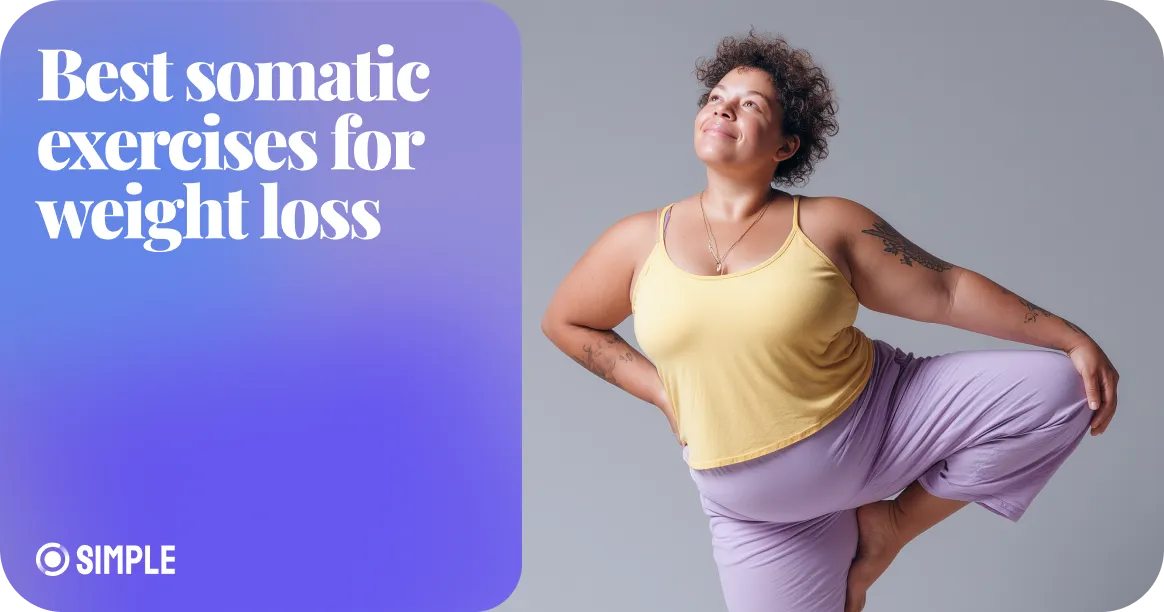
So while somatic exercises might not directly lead to rapid weight loss, their benefits are far-reaching. Think: better posture, more flexibility, less emotional eating, and a renewed sense of connection with your health and fitness goals.
Interested? Read on!
What are somatic exercises for weight loss?
Somatic exercises are slow, controlled movement practices designed to restore your connection with your body and how it moves and feels. The word “somatic” comes from the Greek word soma, meaning the living body, and that’s the whole idea: treating your body as a sensing, feeling system, not just a machine to burn calories or get you from A to B.
So, are somatic exercises for weight loss? Not directly. They’re not high-intensity. They won’t spike your heart rate or boost your metabolism metabolism like intervals or strength training. But they can:
-
Reduce stress, which helps regulate cortisol (the hormone that loves to store extra belly fat.)[8]
-
Improve neuromuscular control and body mechanics, making everyday movement smoother.[2]
-
Boost self-awareness so you make more intentional choices about eating and exercise exercise .
By improving movement, increasing body awareness, and releasing long-held tension, somatic workouts for weight loss create the conditions for healthier habits to take root.
Do somatic workouts really work for weight loss?
We get this a lot: Do somatic exercises really work for weight loss?
The honest answer is … it depends.
If you’re asking, “Do somatic exercises help you lose weight?” in a direct, calorie-burning way? Then the answer’s no.
But if you’re asking, “Can somatic exercises help with weight loss by reducing cravings, improving body composition, and making me feel more in control of my choices?” Then it’s a big, confident yes.
Why? Because chronic stress messes with your metabolism, and high cortisol levels often lead to fat storage and emotional eating. Somatic practices positively shift your nervous system, making it easier for your body to rest, digest, and relax.
Scientific evidence specifically on using somatic workouts for losing weight is limited. However, research on mindfulness, movement therapies like yoga, and stress-reduction techniques suggests real promise when paired with other habits, like healthy eating.[7, 9, 10]
Benefits of somatic workouts for weight loss
Reduces stress and lowers cortisol
By activating the parasympathetic nervous system (our “rest and digest” mode), somatic exercises help reduce stress stress and regulate cortisol, creating better conditions for sustainable weight loss.
Improves body awareness and movement efficiency
As you retrain your nervous system to sense into your body’s movements, you may find it easier to move with less pain and more confidence, leading to a more active life.
May reduce emotional eating
By helping you slow down and listen to your body’s signals, somatic movement may help to break the “eat your feelings” cycle. You’ll tune into real hunger cues and feel more emotionally steady.
Supports recovery and flexibility
Whether you’re stiff from sitting or sore from your last workout, somatic work releases tension, restores posture, and increases mobility—making other fitness efforts more enjoyable and sustainable.
Top 5 best somatic exercises
While there’s no scientific proof that somatic exercises are helpful directly for weight loss, they can support your weight loss goals and create the foundation for meaningful change.
While any exercise can be somatic if you approach it with mindful intention, below are some of the best: 5 tried-and-true exercises that, when you slow down and tune in, become powerful somatic tools. Think of them as a nervous system reboot with some flexibility perks.
Cat-cow
A classic spine-limbering move that connects breath and movement.
How to do it:
Start on all fours. Inhale as you arch your back, lifting your chest and tailbone (Cow). Exhale as you round your spine, tucking your chin and pelvis (Cat). Repeat slowly, syncing breath with motion and noticing how your body feels in each phase.
Pelvic curl
This core-activating exercise promotes spinal mobility and body awareness.
How to do it:
Lie on your back, knees bent, feet flat. Inhale to prepare. Exhale as you slowly peel your spine off the floor, one vertebra at a time, lifting into a bridge. Inhale at the top, then exhale as you roll down. Focus on control and sensation.
Supine twist
A gentle release for the spine and hips.
How to do it:
Lie on your back and hug your knees in. Let them drop to one side, arms out in a T shape. Breathe deeply and let your body settle. Repeat on the other side. Slow, still, and oh-so-soothing.
Shoulder bridge
A great movement for glutes, spine, and posture.
How to do it:
Lie on your back, knees bent. Inhale to lift your hips into a bridge, exhale to lower. Try matching your breath to each part of the movement and notice where you hold tension.
Seated forward fold
Calming, lengthening, and a great chance to notice where your body resists or releases.
How to do it:
Sit with legs extended. Inhale to lengthen your spine. Exhale as you hinge forward, reaching toward your feet. Don’t force it—let gravity do the work. Breathe into areas of discomfort or tightness, and invite softness.
Any movement can be somatic
It’s not about what you’re doing, but how you’re doing it.
When you slow down, tune into your body, and move with awareness, even a simple stretch or walk to the fridge becomes a somatic exercise. It’s about shifting from autopilot to intention, letting your body lead, and listening to your body as you move.
For instance, try somatic walking:
As you walk, focus on the feel of your feet hitting the ground, the sway of your arms, the rhythm of your breath. No phone. No podcast. Just you and your body, reconnecting.
Tips on how to practice somatic exercises effectively
Start with 5–10 minutes a day
You don’t need a 60-minute session. Using somatic exercises—especially if you want to lose weight—is about consistency, not intensity. Short daily practices win over occasional marathons.
Let your body guide the way
Tune into sensation, not performance. If something feels off, pause. If it feels delicious, linger.
Connect breath with movement
Pairing breath with each motion calms your nervous system and deepens the mental benefits of the practice.
Make it your go-to for recovery
On rest days or after tough workouts, add a somatic workout for tension release, active recovery. By increasing your overall activity, you’ll increase your chances of weight loss.
Track how you feel, not just how you look
Notice your energy, sleep, cravings, or mood. These changes often show up before the number on the scale does.

Frequently asked questions
Can I lose weight with somatic yoga?
Daily practice works well because your nervous system thrives on routine and repetition. Start with 1-10 minutes a day.
What are somatic exercises for belly fat?
There’s no targeted fat burn here, but somatic exercises for belly fat work indirectly by reducing stress, lowering cortisol, and decreasing emotional eating patterns.
What is the somatic diet?
The somatic diet isn’t a specific food plan. It’s a holistic approach to eating that emphasizes body awareness, hunger cues, and emotional regulation, rooted in mindfulness and nervous system balance.
What are the side effects of somatic exercises?
The main side effects? Yawning, deeper breathing, spontaneous sighing, maybe even unexpected tears (hello emotional release). All good signs. Just listen to your body and go slow.
Can you do somatic exercises in bed?
Absolutely. Some of the most powerful somatic techniques—like breathing, progressive relaxation, and gentle rolling—can be done right in bed. Perfect for winding down and easing into rest.
- Pascoe MC, Bauer IE. A systematic review of randomised control trials on the effects of yoga on stress measures and mood. J Psychiatr Res 2015; 68: 270–282.
- Lee S-C, Tsai P-H, Yu K-H, et al. Effects of mind-body interventions on immune and neuroendocrine functions: A systematic review and meta-analysis of randomized controlled trials. Healthcare (Basel) 2025; 13: 952.
- Richards AL, Johnson R. Reduction in emotional and uncontrolled eating scores with yoga compared to stretching: A randomized trial. Altern Ther Health Med 2025; 31: 32–39.
- Wang H, Xin X, Pan Y. The best approaches and doses of exercise for improving sleep quality: a network meta-analysis and dose-response relationship study. BMC Public Health 2025; 25: 1371.
- Fincham GW, Strauss C, Cavanagh K. Effect of coherent breathing on mental health and wellbeing: a randomised placebo-controlled trial. Sci Rep 2023; 13: 22141.
- Balban MY, Neri E, Kogon MM, et al. Brief structured respiration practices enhance mood and reduce physiological arousal. Cell Rep Med 2023; 4: 100895.
- Lara DK, Hamel KA, Anderson DI. Somatic movement intervention among older adults to improve body awareness and spine mobility: A pilot study. J Bodyw Mov Ther 2025; 42: 319–330.
- Abraham SB, Rubino D, Sinaii N, et al. Cortisol, obesity, and the metabolic syndrome: a cross-sectional study of obese subjects and review of the literature. Obesity (Silver Spring) 2013; 21: E105–17.
- Yücel ÜÖ, Er BG, Uçar A. The effectiveness of the mindfulness-based dietary intervention on body weight and eating behaviors. J Hum Nutr Diet 2025; 38: e70078.
- Unick JL, Dunsiger SI, Bock BC, et al. A preliminary investigation of yoga as an intervention approach for improving long-term weight loss: A randomized trial. PLoS One 2022; 17: e0263405.